Posts by Maggie Rosenau

LPC releases updated Library Publishing Curriculum Policy Module

By

Updated Policy Module CoverThe Library Publishing Curriculum Editorial Board is pleased to release an updated version of the Policy Module of the Library Publishing Curriculum. One of the roles of the Editorial Board is to keep the Curriculum up to date, and the Policy Module was a priority. Policy is an area where publishing programs interface with the legal and political environment, which has seen dramatic changes since the original Policy Module was written, and these units provide the up-to-date guidance that library publishers need. The units in the updated Policy Module are: 

  • Accessibility by Alexandra Marcaccio
  • Diversity, Equity, and Inclusion by Talea Anderson
  • Preservation by Corinne Guimont
  • Publishing Ethics by Esther Jackson & Michelle Wilson
  • Rights & Rights Management by Perry Collins


The 2023-2026 Editorial Board Members, Johanna Meetz, Joshua Neds-Fox, Chelcie Rowell, John Warren, and Rebecca Wojturska, are grateful to the authors of the new units for sharing their expertise on these topics with the field. 

Format change from original Curriculum

The original Curriculum units consist of a narrative, an instructor’s guide, slides, a bibliography, and sometimes other supplementary materials. For the updated Policy Module, we decided to focus the authors’ efforts on creating the narrative portion. We based this decision on our understanding of how the Curriculum is currently being used, as well as right-sizing the authoring process for ongoing updates (as opposed to the intensive, grant-funded project that created the original version). We invite feedback from the community on this decision, and encourage anyone who is teaching the Curriculum and would benefit from having access to more teaching-oriented resources to contact us at contact@librarypublishing.org. 

About the Curriculum

The full-length Library Publishing Curriculum is a comprehensive document, comprising four modules (Content, Impact, Sustainability, and Policy) as well as an introduction. It is available as a set of teaching materials (hosted by Wayne State University in its repository), as well as in a self-guided course hosted by the Public Knowledge Project (the Policy Module has not yet been updated). 

The Curriculum is a large resource, so the Editorial Board recently released the first of several themed ‘pathways’ through it — this one focused on the parts of the Curriculum most relevant to libraries who are starting a new program. 

LPC Releases 2025–2026 Annual Report

By

Cover image of Annual Report 2025-2026The Library Publishing Coalition is pleased to announce the release of its 2025–2026 Annual Report.

In addition to outlining LPC’s finances, membership, and ongoing inclusion efforts, the Annual Report highlights the release of several new resources, including: 

  • the Library Publishing Creates advocacy website (including Showcase Week content), 
  • new Quick Guides to Digital Preservation for Library Publishers, 
  • an AI Editorial Policy Guide, and
  • Powered by People: Staffing and Capacity in Library Publishing Programs (a report from our 2024-26 Staffing Survey Task Force

This year’s Annual Report also includes an illustrated guide to LPC’s extended network, including strategic affiliates, joint projects, and meta communities!

We encourage community members to share this report with colleagues and administrators who may be interested in getting involved or in understanding what membership dues make possible. 


Forum 2027 banner logo

Save the date: LPForum 2027

By

Save the date for the 2027 Library Publishing Forum, which will be held virtually on May 10–13. Stay tuned for more information and for the upcoming call for proposals!


MOSAIC banner

A new issue of MOSAIC is here!

By

THEME: PRESERVATION

This issue of MOSAIC includes the Preservation Working Group’s new publication, relevant portions of the Library Publishing Curriculum, preservation-related Forum presentations, and a round-up of our strategic affiliates that work on preservation in some capacity.

Read the August 2026 issue here. Enjoy!


2026 Forum Sponsor Highlight: Bridwell Press

By

This year we invited sponsors at the Sustainer Level and above to introduce themselves through narratives of how users engage with their platforms/products. Participants can connect with sponsors during and after the Forum through onsite tables, online sponsor channels in the Discord, and Chats with a Sponsor—a scheduled time for you to share and get feedback from sponsors about a publishing pain point you think they might be able to solve. 

By Michelle Ried, Bridwell Press

Bridwell Library and Press logo

BRIDWELL PRESS:  Where History and Culture Meet Creativity & Poetry

Founded in 2022, Bridwell Press grew out of the desire to develop a sustainable open-access press that supported global voices and approaches creatively, while continuing the legacy of the former SMU Press that closed in 2010. Early contributors included librarians dedicated to better writing pedagogy, a Brazilian jurist seeking novel approaches to religious understanding, and a progressive Jewish theologian laying the groundwork for mutual respect within interfaith dialogue in the Middle East. This was just the beginning.

What has followed is a journey not just of collaboration, but of community that believes in the truest natures of human goodness and the spirit of the creative mind. Through critical scholarship, advanced translation, and innovative verse, Bridwell Press has emerged as a cutting edge publisher of both contemporary research and poetry, and of thousand-year-old historical and literary works rendered into modern English. 

Anthony Elia Welcome Video Still
Click image to watch Anthony Elia’s Welcome

Bridwell Press works with teams of scholars and translators from Dallas and Minneapolis to Rome and Hong Kong, and produces titles from Armenian and Spanish to medieval Japanese and Tatar. Our editorial boards are governed by editors from a diverse group of institutions like SMU, Macalester College, NYU, and Oxford University and provide the highest standards of review and production. 

Some of the most important works in translation come out of zones of conflict or where historical and literary legacies are not well represented, including poetry and scholarship from Ukraine, literature from 1910s Armenia, Cambodian religious writings from the mid-20th century, 14th-century Mongolian poetic and historical writings, and even 8th-century literature from Japan. Seeking to reveal vastly underrepresented works and make them available open access is an honor that we can share with both students and the greater world of readers. 

Here readers can view Bridwell Press Director Anthony Elia welcome folks to reach out to him to talk further about Bridwell’s lists and editorial processes, including their use of Fulcrum as an academy-owned publishing platform.


2026 Forum Sponsor Highlight: Quire

By

This year we invited sponsors at the Sustainer Level and above to introduce themselves through narratives of how users engage with their platforms/products. Participants can connect with sponsors during and after the Forum through onsite tables, online sponsor channels in the Discord, and Chats with a Sponsor—a scheduled time for you to share and get feedback from sponsors about a publishing pain point you think they might be able to solve. 

By Erin Dunigan, Quire

Quire logo

Quire is a digital publishing tool developed and used by Getty since 2016. Quire is designed for longevity, discoverability, and scholarship. Using plain text files, Quire creates online and e-books as authoritative and enduring as print and as vibrant and feature-rich as the web—all without paying a fee or maintaining a complicated server. Quire has been open source since 2022, and a community of individuals, institutions, and museums worldwide uses it for free. In this blog post, we showcase a few examples of how digital scholarship/publishing staff and subject matter faculty members work with Quire to produce beautiful publications. 

Shortly after starting in 2017 as a software engineer working in the Center for Digital Scholarship at Emory University, Yang Li became known as a digital matchmaker for faculty members working on digital projects. Faculty would come to Yang with an idea, and he would experiment to choose which platform would be the best way to bring their scholarship to life. After several years of research and experimentation, Yang chose three tools/platforms that he felt comfortable recommending: WordPress, Manifold, and Quire. 

Yang saw Quire as an elegant way to surface valuable research that might otherwise remain inaccessible. Quire stood out for a few reasons, including the way it

  • outputs a static website that doesn’t require the headache of maintaining a server, 
  • generates PDF and EPUB versions of the website, 
  • enables deep customization, and 
  • is actively maintained by Getty, including up-to-date documentation and training.


Yang recommends Quire to faculty whose work is image-heavy and best suited to a catalogue or monograph format, like the Michael C. Carlos Museum’s 2022 publication And I Must Scream. This exhibition catalogue features both an essay and a catalogue section. The object entry pages in this catalogue are automatically formatted by Quire to include a primary image on the left and artist information, essay, and comparative images on the right, much like a traditional print catalogue. 

Quire has a notable learning curve, requiring navigation of the command line and writing content in Markdown and YAML, quickguide documentation for which is provided on the Quire website. Emory Art History Professor Amanda H. Hellman, together with Professor Annie McEwen and PhD Candidate Ellen Archie, were up for the challenge. Motivated by curiosity and a desire to learn, they did the bulk of the work utilizing Quire’s documentation and occasionally engaging with the user forum. When they brought the publication to Yang and asked what needed to be fixed, he was thrilled to say, “Nothing!” 

More often, Yang is either directly working on a publication or connecting faculty with external help. He is currently assisting with the exhibition catalogue Making an Impression: The Art and Craft of Ancient Engraved Gemstones. Ruth Allen, PhD, Curator of Greek and Roman Art, wanted to include Reflectance Transformance Imaging (RTI). This allows the viewer to adjust the shadows and light as they move their mouse around an image. With some tinkering, Yang customized Ruth’s publication to include this feature, giving readers the opportunity to explore the luminosity of ancient carved gems in an elevated and unprecedented way. 

Yang regularly hears from faculty members that they are pleased with the modern look and feel of their Quire publications, the way the tool structures content, and how it enhances the scholarship through its various multimodal features. After nearly a decade of helping faculty, Yang reflected that Quire is unique in that it “enables you to appreciate the beauty of the project itself; the platform doesn’t get in the way.” 

Quire Video Thumbnail

[Quire Trailer]


LPC releases new AI Editorial Policy Guide

By

AI Editorial Policy Guide CoverThe Library Publishing Coalition is excited to announce the release of a new AI Editorial Policy Guide. This document is designed to help editors and those involved in publishing to develop an AI policy for your publishing program. Sections include policy development and maintenance, the fundamental elements included in an AI editorial policy guide, an annotated list of selected examples of AI policies, as well as further resources to aid your policy development.

This policy was developed by the LPC Professional Development Committee as a follow up to an LPC-hosted webinar on AI Policies which included guest speakers from Ubiquity Press (Imogen Clarke) and In the Library with the Lead Pipe (Ryan Randall and Brittany Paloma Fiedler). We encourage you to watch the webinar recording as you think about your AI policy planning.

This document is being released under a Creative Commons Attribution license (CC BY), so we encourage further distribution and adaptation of this guide.


Report on current state of staffing in library publishing

By

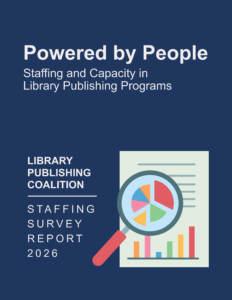
The Library Publishing Coalition is pleased to announce the release of the report, Powered by People: Staffing and Capacity in Library Publishing Programs and to invite the community to a webinar on June 2nd where we will share highlights and answer questions.

LPC Staffing Survey Report Cover Page

About the report: In summer 2025, LPC’s Staffing Survey Task Force released a survey of library publishing programs to develop a deeper understanding of how and by whom library publishing programs are staffed. The report we are releasing today outlines results and discusses key takeaways, including:

  • Good practices and pain points

  • Alignment between output expectations and institutional support of publishing programs

  • Intentionality of staffing changes and subsequent outcomes

  • Future needs and workload changes shaped by new technologies and requirements

Powered by People: Staffing and Capacity in Library Publishing Programs serves as an avenue for learning about and reflecting on labor-related decisions and changes happening within the library publishing community.

  • Citation: Powered by People: Staffing and Capacity in Library Publishing Programs. (2026) Library Publishing Staffing Survey Report. Atlanta, GA: Educopia Institute. https://doi.org/10.5703/1288284318627

Webinar info: The LPC Staffing Survey Task Force will host a webinar on Tuesday, June 2 from 12-1pm EDT to discuss the results, process, and takeaways from the Staffing Survey Report. Join us for an overview of the survey report, a highlight of interesting results, and potential future research directions as well as a look behind the scenes at developing and administering the survey. This webinar will be recorded and shared for those unable to attend synchronously.

Advance registration is required. After registering, you will receive a confirmation email containing information about joining the meeting.